How to Track, Understand, and Act on Regulations Using AI
Why Traditional Regulatory Tracking No Longer Works
This is continuation of our Part 1 - Why Email Breaks Insurance Compliance - and How ComplyOS Fixes It
Regulatory change is constant.
Manual tracking is slow.
Email-based processes break at scale.
Why Traditional Regulatory Tracking No Longer Works
Regulations today are:
High-volume
Unstructured
Multi-jurisdictional
Fast-changing
Common problems with legacy approaches:
Missed updates buried in emails
PDFs and bulletins stored in silos
Manual interpretation delays
No clear ownership or accountability
Result: Compliance becomes reactive instead of proactive.
What Does “AI-Powered Regulatory Tracking” Mean?
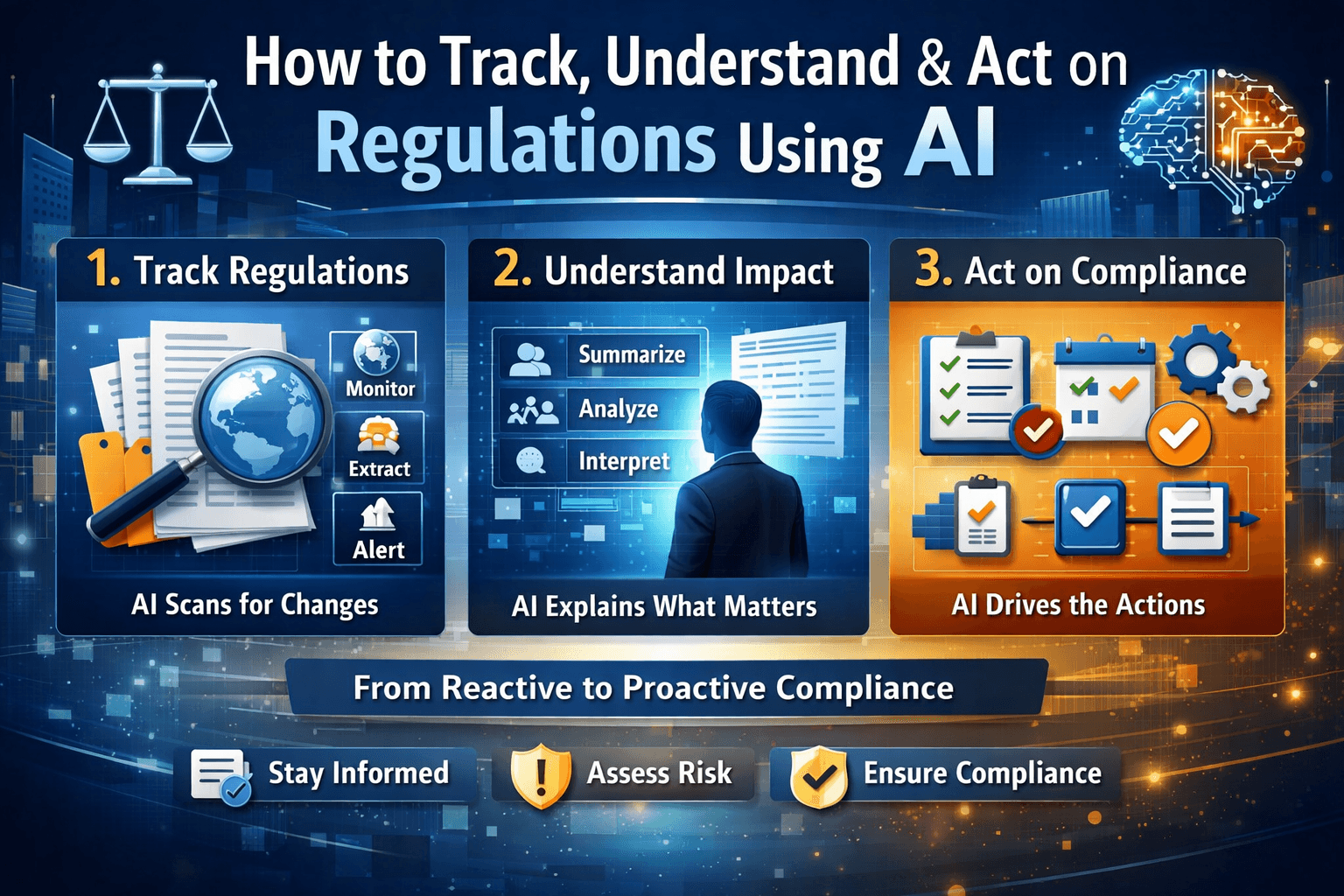
AI-driven regulatory tracking uses machine intelligence to:
Continuously monitor regulatory sources
Automatically extract relevant changes
Interpret impact across teams
Trigger actions, workflows, and alerts
This is not just search.
It’s end-to-end regulatory intelligence.
Step 1: Track Regulations Automatically Using AI
Continuous Regulatory Monitoring
AI systems scan:
Regulatory websites
Bulletins and circulars
Rulebooks and amendments
PDFs, Word files, and notices
Key benefits:
No manual checking
No missed updates
24/7 monitoring
Smart Relevance Filtering
AI filters noise by:
Line of business
Jurisdiction
Product type
Functional relevance
You only see what matters to you.
Step 2: Understand Regulatory Changes with AI
Tracking is useless without understanding.
AI-Powered Summarization
AI converts dense regulatory text into:
Plain-language summaries
Section-by-section breakdowns
Key obligations and deadlines
Contextual Interpretation
Advanced systems identify:
What changed vs. what stayed the same
New vs. amended vs. repealed rules
Effective dates and transition periods
Impact Mapping Across Teams
AI automatically answers:
Who is impacted?
Which teams need to act?
What processes change?
Examples:
Compliance
Marketing
Product
Legal
Operations
IT
Step 3: Act on Regulations Using AI Workflows
Understanding alone doesn’t ensure compliance.
Automated Task Creation
AI can:
Generate action items
Assign owners
Set deadlines
Track completion
Built-In Collaboration
Replace email chaos with:
Shared workspaces
Comment threads
Audit-ready decision logs
Evidence & Audit Trails
AI systems maintain:
Version history
Change rationale
Proof of compliance
This is critical for exams and audits.
How AI Transforms Compliance from Reactive to Proactive
Before AI
Manual tracking
Delayed understanding
Last-minute fixes
With AI
Real-time visibility
Early risk detection
Confident, documented actions
Compliance becomes a business enabler, not a bottleneck.
Key Capabilities to Look for in an AI Regulatory Platform
When evaluating solutions, prioritize:
✅ Continuous regulatory monitoring
✅ Plain-language summaries
✅ Impact analysis by team
✅ Workflow automation
✅ Audit-ready documentation
✅ Role-based dashboards
FAQ: AI for Regulatory Tracking & Compliance
What is AI regulatory tracking?
AI regulatory tracking uses artificial intelligence to monitor regulatory updates, extract relevant changes, and notify impacted teams automatically.
How does AI help understand regulations?
AI summarizes complex regulations, highlights key changes, and explains impact in plain language—saving hours of manual analysis.
Can AI replace compliance professionals?
No. AI augments compliance teams by handling tracking and analysis, allowing experts to focus on judgment and strategy.
Is AI-based compliance audit-ready?
Yes. Modern AI platforms maintain complete audit trails, version control, and evidence logs for regulators and exams.
Which industries benefit most from AI regulatory intelligence?
Highly regulated industries like insurance, banking, healthcare, fintech, and energy see the highest ROI.
Related Articles
Final Takeaway
Regulations will only increase.
Manual processes won’t scale.
AI enables organizations to track faster, understand better, and act with confidence - every single time.
This is continuation of our Part 1 - Why Email Breaks Insurance Compliance - and How ComplyOS Fixes It
Regulatory change is constant.
Manual tracking is slow.
Email-based processes break at scale.
Why Traditional Regulatory Tracking No Longer Works
Regulations today are:
High-volume
Unstructured
Multi-jurisdictional
Fast-changing
Common problems with legacy approaches:
Missed updates buried in emails
PDFs and bulletins stored in silos
Manual interpretation delays
No clear ownership or accountability
Result: Compliance becomes reactive instead of proactive.
What Does “AI-Powered Regulatory Tracking” Mean?
AI-driven regulatory tracking uses machine intelligence to:
Continuously monitor regulatory sources
Automatically extract relevant changes
Interpret impact across teams
Trigger actions, workflows, and alerts
This is not just search.
It’s end-to-end regulatory intelligence.
Step 1: Track Regulations Automatically Using AI
Continuous Regulatory Monitoring
AI systems scan:
Regulatory websites
Bulletins and circulars
Rulebooks and amendments
PDFs, Word files, and notices
Key benefits:
No manual checking
No missed updates
24/7 monitoring
Smart Relevance Filtering
AI filters noise by:
Line of business
Jurisdiction
Product type
Functional relevance
You only see what matters to you.
Step 2: Understand Regulatory Changes with AI
Tracking is useless without understanding.
AI-Powered Summarization
AI converts dense regulatory text into:
Plain-language summaries
Section-by-section breakdowns
Key obligations and deadlines
Contextual Interpretation
Advanced systems identify:
What changed vs. what stayed the same
New vs. amended vs. repealed rules
Effective dates and transition periods
Impact Mapping Across Teams
AI automatically answers:
Who is impacted?
Which teams need to act?
What processes change?
Examples:
Compliance
Marketing
Product
Legal
Operations
IT
Step 3: Act on Regulations Using AI Workflows
Understanding alone doesn’t ensure compliance.
Automated Task Creation
AI can:
Generate action items
Assign owners
Set deadlines
Track completion
Built-In Collaboration
Replace email chaos with:
Shared workspaces
Comment threads
Audit-ready decision logs
Evidence & Audit Trails
AI systems maintain:
Version history
Change rationale
Proof of compliance
This is critical for exams and audits.
How AI Transforms Compliance from Reactive to Proactive
Before AI
Manual tracking
Delayed understanding
Last-minute fixes
With AI
Real-time visibility
Early risk detection
Confident, documented actions
Compliance becomes a business enabler, not a bottleneck.
Key Capabilities to Look for in an AI Regulatory Platform
When evaluating solutions, prioritize:
✅ Continuous regulatory monitoring
✅ Plain-language summaries
✅ Impact analysis by team
✅ Workflow automation
✅ Audit-ready documentation
✅ Role-based dashboards
FAQ: AI for Regulatory Tracking & Compliance
What is AI regulatory tracking?
AI regulatory tracking uses artificial intelligence to monitor regulatory updates, extract relevant changes, and notify impacted teams automatically.
How does AI help understand regulations?
AI summarizes complex regulations, highlights key changes, and explains impact in plain language—saving hours of manual analysis.
Can AI replace compliance professionals?
No. AI augments compliance teams by handling tracking and analysis, allowing experts to focus on judgment and strategy.
Is AI-based compliance audit-ready?
Yes. Modern AI platforms maintain complete audit trails, version control, and evidence logs for regulators and exams.
Which industries benefit most from AI regulatory intelligence?
Highly regulated industries like insurance, banking, healthcare, fintech, and energy see the highest ROI.
Related Articles
Final Takeaway
Regulations will only increase.
Manual processes won’t scale.
AI enables organizations to track faster, understand better, and act with confidence - every single time.

Smruthi Kulkarni
Jan 17, 2026
Contact Now!
Let’s Connect. Reach out and we’ll get back to you as soon as possible.
Contact Now!
Let’s Connect. Reach out and we’ll get back to you as soon as possible.
Latest posts
Discover other pieces of writing in our blog


Foundational Content
© Copyright 2025. All rights reserved.